
· by Michael Blair, Nashville's Electrician
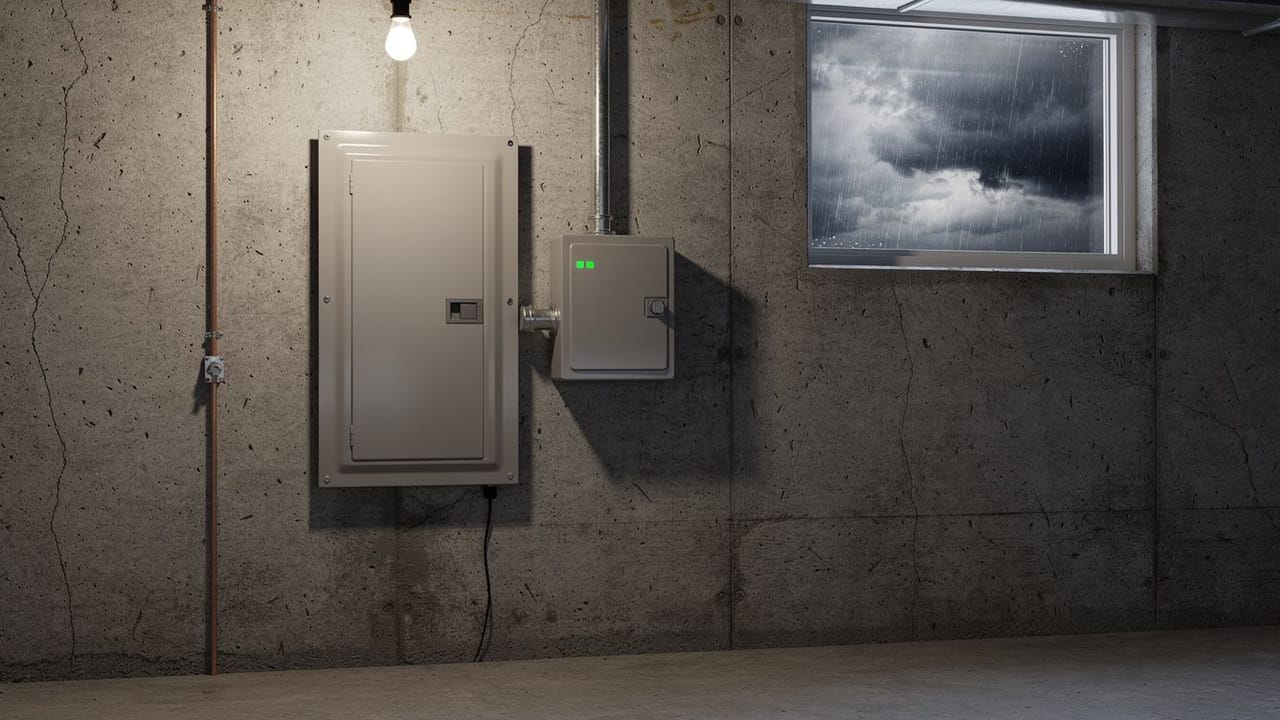
Summer storms are what get people asking us about surge protection, and lightning is only part of the answer. A NIST draft on protecting end-user equipment sorts surges by where they come from: from outside the house, lightning and the utility switching its system, and from inside it, mostly loads switching on and off, a breaker or fuse clearing a fault among them. A protector at the panel is aimed at the first group, which is why we treat it as part of the service and look at it whenever we have a panel upgrade open.
What does a whole-house surge protector do?
It works at the service entrance, ahead of the branch circuits. UL 1449, the standard for surge protective devices, sorts them by where they are installed: Type 1 and Type 2 units are permanently connected at the service, on the line side or the load side of the main overcurrent device, while Type 3 is the point-of-use kind, the cord-connected strip or plug-in unit. Being at the service is what lets a panel unit cover the hardwired equipment a power strip never touches: the HVAC control board, the oven, the water heater controls, the garage door opener, LED fixtures.
Those are the failures that hurt now, because a furnace, a range or a washer runs on a circuit board, and a board is a part to be ordered and fitted rather than a strip to be thrown out. A 1999 EPRI and NIST paper on a consumer surge guide made the point a generation ago: as home appliances and electronics grew more sophisticated they grew more susceptible to surge damage, which the authors traced most often to switching surges and lightning.
Layered protection is the standard approach
A panel device takes the large surges arriving from outside; protectors at sensitive equipment take what gets past it and what the house makes on its own. The NIST draft on end-user equipment describes a well-chosen service-entrance device as the guardian at the service entrance, relieving stress on the protectors further in, and it still makes a case for a device at the point of use even after the service-entrance protection has brought the remaining surges down to an acceptable level.
Neither replaces the other. A panel unit alone leaves sensitive electronics under-protected; strips alone leave every hardwired appliance unprotected. If you would like the panel side looked at before you buy anything, ask us for an estimate and we will check the panel, the grounding and where the cable and phone lines come in.
What to look for
A device listed for the application, with a status indicator and instructions that say what the indicator means. These devices do not last forever: in NIST’s paper on what the lights on a surge protector tell you, Martzloff lists severe overstress beyond the rating, natural aging and misapplication among the reasons they fail, and notes that some designs, once the protective part has failed, leave the load powered but unprotected. Several of the seventeen units he examined said very little about what their indicator lights meant, and UL 1449 as revised in 1996 no longer required a visible indication at all, so we go by each manufacturer’s instructions instead of assuming a lit light means a working unit.
Grounding and bonding decide how well the whole arrangement works. In one case history in the EPRI and NIST paper, a house’s cable TV shield was grounded to its own questionable rod and not bonded to the grounding of the power service entrance, which the authors call a clear violation of the National Electrical Code, and the same paper found that electronics can be damaged by surges coming in through their communications port, so protecting the power port alone is not enough. In an older house, the kind we cover in our post on old wiring in Nashville homes, checking the grounding electrode system and bonding the cable and phone entrances to it is part of the job rather than an upsell. Metro Nashville works to the 2023 National Electrical Code, the edition named on Metro Codes’ adopted codes list, and that is the edition we install the panel unit and its connections under.
- Listed Type 1 or Type 2 device at the panel
- A status indicator, read the way the manufacturer’s instructions say
- Verified grounding, with the cable and phone lines bonded to it
- Point-of-use protection at sensitive equipment
- Protection on incoming coax and data lines too
What can’t a surge protector stop?
A nearly direct lightning strike is the case no one can promise to handle. The EPRI and NIST paper calls it rare and says that, short of a thorough mitigation study and extensive protection work, there is little that can be done in an ordinary residential setting to prevent the damage. The protectors are for everything else: lightning some distance off, the utility switching its lines, and the switching that goes on inside the house.
It also does nothing to keep the power on. A surge protector limits overvoltage; when the power drops out, the equipment drops with it. For a computer or network gear that has to ride through a blink, we point people to a battery backup at the equipment, and keeping the whole house running through an outage is a question for a generator and transfer switch.
Sources
- F. Martzloff, NIST, Surge Protection of End-User Equipment (IEC working draft, 1995) — External surges (lightning, utility switching) and internal surges (load switching, fault clearing by fuses or breakers); service-entrance SPD as guardian; case for an SPD at the point of end-use as well.
- UL 1449, Standard for Surge Protective Devices, Edition 5 (UL standards store) — Type 1 and Type 2 are permanently connected SPDs at the service, line side or load side of the service overcurrent device; Type 3 is point of utilization (cord-connected, plug-in).
- Key, Nastasi, Phipps, Martzloff and May, Update on a Consumer-Oriented Guide for Surge Protection, PQA’99 (1999) — Appliances more susceptible as they grow sophisticated; most often switching surges and lightning; unbonded cable TV shield case history; communications-port damage; little can be done for a rare nearly direct strike.
- F. Martzloff, NIST, What Are the Lights on Your Surge Protector Telling You? (1998) — Failure causes: overstress, natural aging, misapplication; some failures leave the load powered but unprotected; indicator meaning poorly explained; 1996 UL 1449 no longer required a visible indication.
- Metro Nashville Codes, Adopted Codes List — 2023 National Electrical Code in force in Metro Nashville.
FAQ
Whole-House Surge Protection and Nashville Storms — questions
Is a whole-house surge protector worth it?
For most Nashville houses we think so, because it is the only layer that covers the hardwired appliances, and most of those now run on electronics. It is a one-time install at the panel, and we price it for your panel and its grounding before you decide. The case is stronger the more of your heating, cooking and laundry equipment is recent.
Does it replace my power strips?
No. The panel device handles large events arriving from outside; strips handle what gets past it and the surges made inside the house as loads switch on and off. We recommend both, with the panel unit as the first layer and point-of-use protection at the equipment you care most about.
How long does a surge protector last?
There is no fixed lifespan. NIST research lists surges beyond the device’s rating, natural aging and misapplication among the reasons they fail, so it depends on what your house sees and how the unit was installed. Most have an indicator light, but what it shows varies by product, so we suggest looking at it a couple of times a year and reading it the way the instructions say, since some failed units keep the power on with no protection left.
Do whole house surge protectors work?
For the surges they are built for, yes: lightning some distance away and the utility switching its lines, caught at the panel before they reach the branch circuits. How well depends on the grounding and bonding behind the device, and nothing can promise protection from a nearly direct strike. Point-of-use protectors still handle what gets past.