
· by Michael Blair, Nashville's Electrician
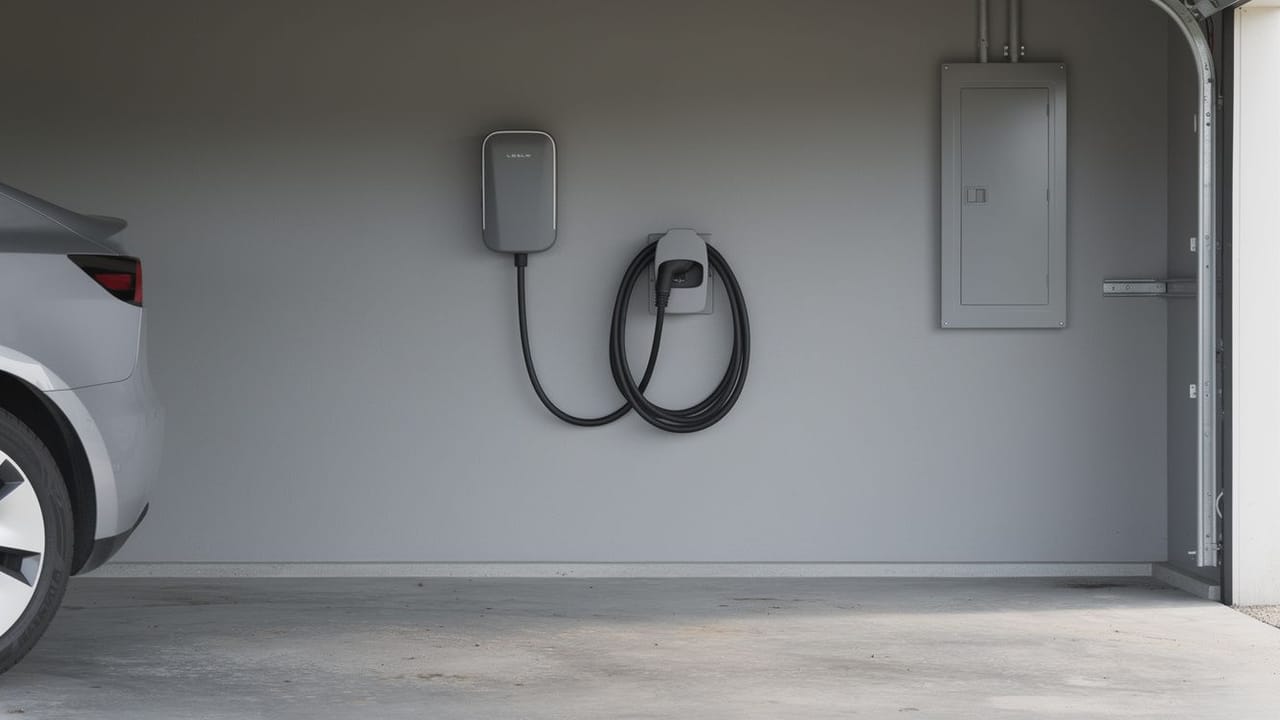
Most people who drive an electric car charge it overnight at home, according to the Department of Energy’s Alternative Fuels Data Center, and the install itself is usually straightforward. Two things decide what a home EV charger installation costs: how far the panel is from the parking spot and whether the service has room.
What does a Level 2 home charger need?
Level 2 runs on 240 volts, and fueleconomy.gov’s charging page puts it at about 25 miles of range per hour of charging on average, anywhere from a few miles to around 40 depending on the car. We give it a new circuit of its own, sized to the charger. The same page says Level 2 may be worth the money for a car with a large battery that’s driven 50 or more miles a day on electricity.
Level 1 uses an ordinary 120 volt outlet and adds about 5 miles of range an hour by the same figures. That sounds slow, but the AFDC’s home charging page says many owners cover their daily driving with Level 1 overnight, provided there’s an outlet on a dedicated branch circuit near where they park. With a short commute, try it for a few weeks before buying anything.
The load calculation decides feasibility
Some homes don’t have the capacity for Level 2, and an electrician can tell you whether yours does, as the AFDC puts it. We work that out with a load calculation: the loads the house already carries against the size of the service. Whether a 100 amp service can take a charger depends on that arithmetic, and our post on when a panel actually needs upgrading covers what else the same calculation decides.
When the numbers are close, we look at whether a load management device, set to hold the charger back while the range, the dryer or the air conditioning is drawing heavily, can stand in for more capacity. Sometimes that’s enough to skip a service upgrade. When it isn’t, the panel or service upgrade comes first, and we’d rather say so before the charger goes on the wall.
What does an EV charger installation cost?
The unit is the predictable part: fueleconomy.gov puts home charger units at roughly $400 to $1,000, and says installation depends on the electrician, how complex the job is and any permits or fees. In our experience the complexity is mostly distance. A charger on the garage wall directly behind the panel is a short job; a detached garage across the yard means a trench, conduit and a much longer run.
After that comes whether a panel space exists, whether the service needs upgrading, whether the run is surface-mounted or hidden in finished walls, and the permit. In many areas a site plan has to be approved before installation, the AFDC notes. In Nashville, Metro Codes’ trades permit page says licensed contractors with an e-permit account apply for electrical trade permits online, and anyone else applies at the Department of Codes and Building Safety. Across most of the rest of Tennessee, the State Fire Marshal’s electrical permit program issues the permits and handles residential inspections, though some jurisdictions are exempt from it.
- Distance from panel to parking spot
- Available panel space, or a subpanel
- Whether the service needs upgrading
- Trenching for a detached garage
- Hardwired versus a 14-50 receptacle
Hardwired or plug-in
A NEMA 14-50 receptacle lets you unplug the unit and take it with you, which is why people ask for it. Metro Nashville builds to the 2023 National Electrical Code, the edition on Metro Codes’ adopted codes list, and before we price a plug-in install we check what that edition asks of the receptacle, ground-fault protection included, because it can add cost. Our post on where GFCI and AFCI protection is required covers the rest of the house.
Hardwiring leaves the receptacle out altogether, and it’s what we usually suggest when the charger is staying with the house. Either way, the AFDC notes that the National Electrical Code treats EV charging as a continuous load, so the circuit is planned for a charger that runs for hours at a stretch. If you want the distance and the load worked out for your house, ask us for a free estimate.
Sources
- U.S. Department of Energy, Alternative Fuels Data Center, Charging Electric Vehicles at Home — Most EV drivers charge overnight at home; Level 2 is 240 V; many owners meet daily driving on Level 1 with an outlet on a dedicated branch circuit; electricians assess capacity and some homes lack it; permits may be required and site plans in many areas; NEC treats EV charging as a continuous load; consult vehicle maker guidance
- U.S. Department of Energy and EPA, fueleconomy.gov, Charging Your Plug-in Electric Car — Level 1 about 5 miles of range per hour; Level 2 about 25 on average, a few to around 40 by vehicle; Level 2 may be worth it at 50+ miles a day; home units about $400 to $1,000, installation depends on complexity and permits
- Metro Nashville Codes, Adopted Codes List — Metro lists the 2023 National Electrical Code among its adopted codes (BL2025-898)
- Metro Nashville Codes, Obtaining a Trades Permit — Electrical trade permits; licensed contractors with an e-permit account apply online, others at the Department of Codes and Building Safety
- Tennessee Department of Commerce and Insurance, State Fire Marshal, Electrical Permits — State electrical permits issued throughout most of Tennessee, residential inspections by contracted deputy inspectors, exempt jurisdictions listed
FAQ
Installing an EV Charger in a Nashville Home — questions
Do I need a permit for an EV charger in Nashville?
Assume so and check before work starts. The Department of Energy says charging equipment has to meet local and state codes and that permits may be required by the local permitting authority. A charger usually means a new 240 volt circuit, sometimes a panel change or a service upgrade, and Metro Codes issues electrical trade permits for that kind of work. The inspection is worth having on a circuit that will carry a heavy load for hours, most often overnight.
Can my 100 amp service handle a car charger?
It can, and a load calculation is what answers it rather than a rule of thumb. Where the numbers are close, a load management device that keeps the charger from running at the same time as the range or the air conditioning may make it work without a service upgrade. Whether it does is a question for the calculation, not a guess made before it.
Is a 50 amp circuit better than 40?
Only if your car can use it. The federal fueleconomy.gov charging page says Level 2 speed varies a great deal from one vehicle to another, and the Department of Energy suggests reading the car maker’s guidance before buying equipment. Match the circuit to the charger and to what the car can actually take, and factor in whether you might change vehicles.
How long does it take to charge an EV at home?
That turns on the charging level and the car. By fueleconomy.gov’s figures, Level 1 on an ordinary 120 volt outlet adds about 5 miles of range an hour, and Level 2 on 240 volts adds about 25 on average, anywhere from a few to around 40 depending on the vehicle. Most drivers simply charge overnight.